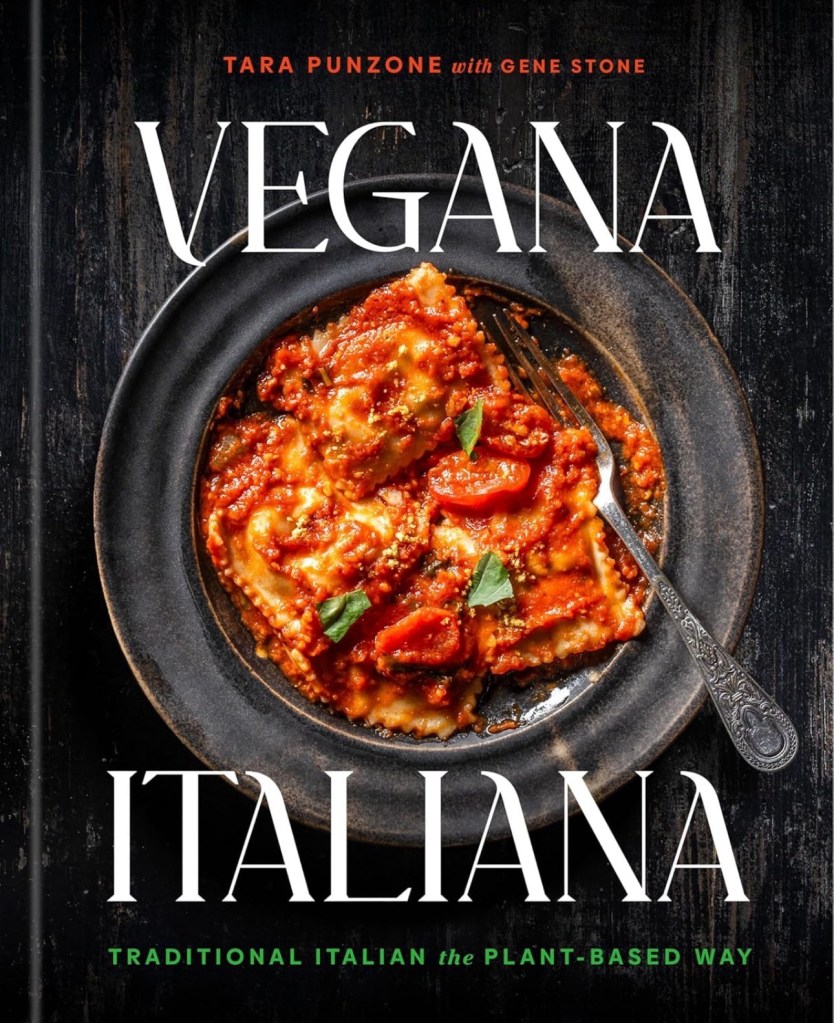
Gone are the days where our only vegan pasta option is marinara!
Vegan options at many Italian restaurants in my area are usually limited to pasta with marinara sauce without the cheese. I was glad to have a place at the table, but after ordering the same dish at every Italian restaurant, I was ready for some variety. Most Italian cookbooks from my library relied heavily on dairy cheese, so I looked online and found Tara Punzone’s cookbook, Vegana Italiana (written with Gene Stone), which offers over 100 recipes of veganized Italian cuisine. So far I have attempted the pasta dishes, sauces, and cheeses but Vegana Italiana also offers recipes on making pasta from scratch as well as salads, soups, first courses, second courses, and dessert.
Tara Punzone is the owner and chef of Pura Vita, a vegan Italian restaurant in West Hollywood, California (Yelp page).
Prior to opening this book, my Italian was mostly limited to musical terms (allegro!) and designer labels (Dolce and Gabbana). I loved eating pasta and could throw together some dry pasta and jarred marinara sauce, but my familiarity with dishes was limited to Alfredo, marinara, vodka, pesto, Chef Boyardee’s canned ravioli, and the mushy elementary school cafeteria spaghetti that was scooped like ice cream onto styrofoam trays. (If any of you remember that school lunch spaghetti, let me know!)
Through Vegana Italiana, Tara Punzone has introduced me to cacio e pepe (DIVINE), spaghetti a la puttanesca (spicy and salty, yum!), and spaghetti aglio, olio, e peperoncino (simple and tasty).
Al Dente
A useful technique I learned from this book is to cook the pasta only a little more than half the time as instructed on the box, and then add pasta water to the sauce. This results in the noodles ready to soak up more moisture and flavor from the actual pasta sauce, and an al dente texture—deliciously firm to the bite.
Loose-agna
Emboldened by my success with the other recipes in the cookbook, I decided to play fast and loose with the sauce portions in the lasagna pura. I ended up with a mountain of wet pasta in which the lasagna kept slipping around the sauces. Lesson learned: follow the directions so that my lasagna looks like historic layers of geological sediment rather than messy hot lava.
Adapting Ingredients to Fit My Budget and Tastebuds
At first glance, some of the traditional ingredients were intimidating for my budget. Canned San Marzano tomatoes, highly regarded as the best for making pasta sauces, go for about $6 a can from what I’ve seen online! I’ve adapted the recipes to my wallet and pantry by using cheaper alternatives like regular tomatoes where the recipe calls for San Marzano tomatoes, and by occasionally going without the toppings like parsley or the crumbly bread.
Also…in the course of preparing dishes from this cookbook, I learned that fresh parsley tastes like soap and peppery lawn mower clippings to me! I thought it was only cilantro that did that to certain people. Since my taste buds are cool with cilantro I may consider using fresh cilantro where parsley is listed as an ingredient.
Among its recipes, Vegana Italiana also offers recipes for creating pasta noodles from scratch. I’d love to make these one day but in the meantime (let’s face it), I have a newborn! My main goal with this cookbook was to learn how to make more dishes, so to save time I’ve made them using store-bought ingredients like marinara sauce and dried pasta. The exception to this would be the creamy sauces like Alfredo, and cheeses like cashew ricotta and mozzarella.
Since vegan Alfredo sauces are less readily available than marinara (and expensive at around $9 a jar), I’ve made the full batch of Tara Punzone’s cashew-based Alfredo sauce and stored the extra in glass jars in my fridge for later use. It’s heavenly, by the way: creamy and rich.
My adaptations may be a bastardization of the cookbook but my point is that although the recipes in Vegana Italiana occasionally list specific ingredients like a certain type of salt or a canned tomatoes from a certain region, they are highly adaptable and flexible to one’s budget, taste buds, and pantry. If you want to be true to the restaurant-quality, original recipe then you have the information you need, and if you want to substitute ingredients with cheaper alternatives to fit your budget and pantry then you can do it and still create a great-tasting dish. This is a strong plus to me as a cookbook: for the price of a plate of pasta you can learn to make unlimited, obscene quantities of pasta wherever you are. For the price of a single plate of pasta (~$25), I’ve already made over $200 worth of pasta dishes.
Where to Find Vegana Italiana
Bookshop.org (support your local indie bookstore)
Veganizing Cuisines Around the World
I’m curious, what other cookbooks out there have deliciously veganized a culture’s cuisine for you? Leave a comment with your thoughts!
 Eden Onpeng