Tag: family

  • Seeing Dead People: where one’s past bleeds into the present

    Seeing Dead People: where one’s past bleeds into the present

    As I was about to give birth to my firstborn child, I began to see dead people in the faces of the people around me.

    It started during the second night of attempted labor induction. My husband was sleeping in the couch next to my bed. I lay in my bed, fading in and out of sleep, partially dilated and waiting for my baby to come.

    The door opened. One of the assistant night nurses walked into my room to take my blood pressure. I looked at her, saw my late friend Megan’s face, and did a double-take to check my reality. From her fine-textured blond hair to her blue eyes and the freckles on her face, and even her calm, rational demeanor, this nurse was my late friend Megan’s doppelganger. Megan had passed away suddenly in 2019 from a heart attack. I had seen her a few days before she died, and she had mentioned having angina and had an appointment with her cardiologist scheduled for the following week. But then her brother reached out to me when I was at work a few days later and told me that Megan had passed away in her condo.

    Although I knew this was not Megan, seeing someone with Megan’s face, hair, and body being alive and well in the world filled me with a sense of peace. It was like peering into a parallel universe in which a version of her was alive.

    I tried not to stare too hard.

    Was I going insane, trying to find the familiar in the unfamiliar?

    Or was my transition into motherhood bringing up feelings of loneliness and memories of old faces? I would have loved for Megan and my sister to meet Baby Daniel. And although I am willfully estranged from my parents, I grieve the relationship I wish I had with them…an emotionally safe one that does not exist.

    Or was I dying? Isn’t it a thing that people see their departed loved ones right before they die?

    Ultimately, the induction failed. After reaching 7 centimeters of dilation, I burned with fever from amniocentesis and Baby Daniel’s heart rate began dipping with each contraction. The nurse and doctor spoke to me and a few minutes later, I was rolled into the operating room for a c-section. Compared to the two nights of attempted labor induction, the c-section was quick and completed after 40 or so minutes.

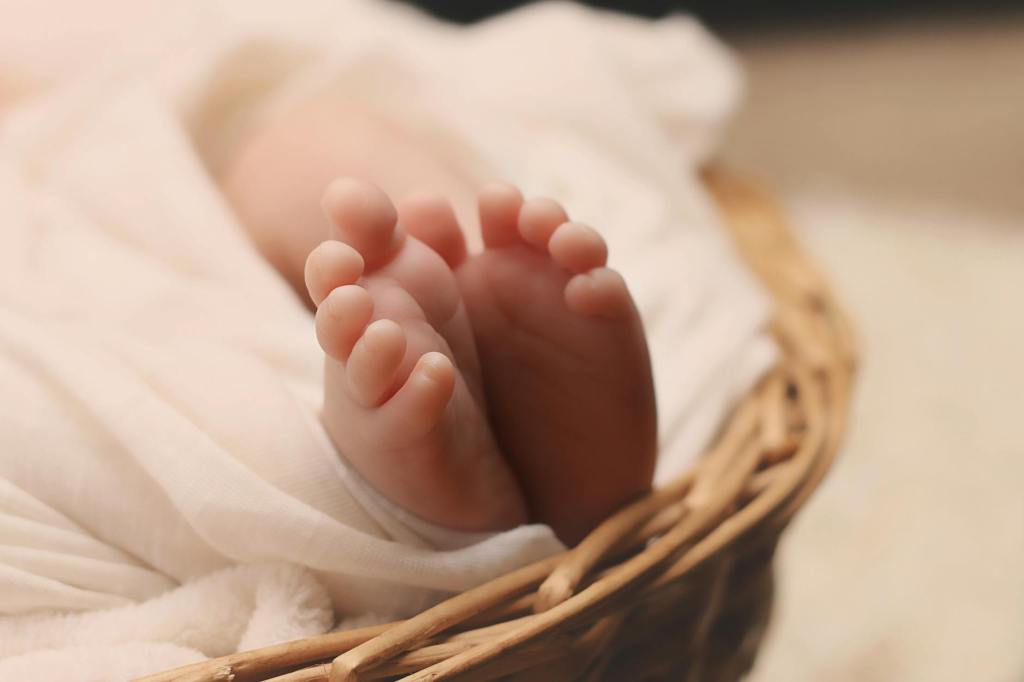
    After the c-section, Baby Daniel was placed in a clear plastic bassinet in our postpartum room, next to my hospital bed. I reached over the edge of the bassinet to hold his tiny, soft hands—and before my eyes flashed the memory of my mother holding my sister’s stiff, gray hands in the casket.

    I gazed at Baby Daniel and saw the baby eyes of my sister staring back at me. But perhaps all newborns look the same: freshly decompressed from being squished inside a uterus for the past several months.

    Daniel was conceived not long before or after my sister’s death. Because of the close timing of the two events, I could not think of one without remembering the other.

    I have found it is more socially acceptable to celebrate than it is to grieve. Celebrations are social, but grief is personal. One’s celebration makes others feel good. One’s loss makes others feel uncomfortable—partly because different people grieve differently and we don’t know how to comfort everyone (some want to be left alone, others don’t want to be alone). Grief has a shelf life, a socially accepted window of time in which it is okay, or even expected, to express grief, and after that window closed, I felt I was supposed to shift, at least publicly, to being excited about my pregnancy. It was easier for others to celebrate with me about the pregnancy than to grieve with me about my sister. It felt like I was supposed to be excited now since I was pregnant, even though my sister’s death was nearly as fresh as my pregnancy.

    But the thing was, although I was happy about the pregnancy, I was still dealing with the emotional fallout of my sister’s suicide, my estrangement from my parents, and the childhood trauma I had spent most of my adulthood avoiding.

    Needing the space and time to grieve, I withdrew into myself.

    And now, as I navigate new parenthood and Baby Daniel’s first days in this world, my mind straddles the past and present, grasping for connections, no matter how tenuous.

    My Mother’s Motherhood

     As a new parent, I have finally reached the same life stage I’ve only ever known my parents to be in. My mom had me when she was 20. My dad was 27. During the dark hours of the morning I wonder what it might have been for my mom, who had met my dad through a matchmaker in her village and then moved across an ocean to marry him and have a baby without any family or extended relatives in America.

    Baby knowledge was harder to come by in 1990, when I was born. Nowadays I can enter a search or question in Google or parenting forums for informal advice and parenting perspectives and anecdotes, but back then, my mom would have relied on whatever she learned while growing up or asking people, or maybe a book. Without her “village,” my mom was left to handle a newborn baby equipped with only her own knowledge and instincts. I don’t know how she treated me as a baby.

    When I was six, my brother was born, at 8.5 pounds. I pretended to sleep while my mom held and screamed at my baby brother to sleep. Her thunderous voice and the rage behind it scared me. Silently, beneath the covers of my bed, I begged to God to make my brother stop crying. But he would keep crying all night long.

    My sister was born seven years after my brother, at 10.5 pounds. She would also cry a lot at night. While trying to rock my crying sister to sleep, my mom would get frustrated and say things like “hope your whole family dies” (sounds more succinct in Chinese) and “I wish I had aborted you,” which makes me suspect my sister was a surprise baby.

    Nowadays, a web search reveals tips and advice for dealing with a fussy baby. And a foray into parenting forums would find other parents with whom one could commiserate about baby sleep issues. My mom had none of these resources in the ‘90s. On top of that, my mom had left behind her family and friends when she moved to the United States to marry my dad.

    On one hand, my mom was making the most of what she had. But then I remember the physical, emotional, and sexual abuse she inflicted on me and the rest of the family—deep harm that her lack of knowledge or trauma cannot justify, harm that eroded the confidence of her children, and harm that comes from denying the harm that she and my dad inflicted. After remembering these things, I remind myself that having a hard life does not excuse her decision to abuse us. Then I feel angry. And the cycle of thought repeats until I get tired of it and start scrolling through Amazon for a quick distraction.

    I’m filled with gratitude for the resources I do have today. My husband shares household tasks and nighttime shifts with me. I go to therapy. I have access to internet resources and forums that offer tips and anecdotes that help me feel less alone. I’m no longer in touch with my toxic parents so they cannot add to my level of stress.

    Regression & Upheaval

    Becoming a new mom has sifted old memories from the bottom of my pond into the surface. How was my mom when I was a child? How will I be as a mother to my own child? I catch myself sliding back into memories, hangups, and issues I thought I had already processed. Childhood abuse. Sexual abuse. Why are we going through this again?

    In a recent therapy session I expressed grief about the relationship I wished I’d had with my parents. But this was something I’d worked through several months ago. My therapist asked if I was reconsidering my estrangement (a hard no) or if I just wanted to express my feelings of grief (yes), and suggested that instead of using the word “regress,” I can use the word “upheaval” to reframe this resurgence of old memories amid my transition into motherhood.

    I have also been thinking about my sister’s suicide. My mind has preoccupied itself with futile exercises such as wondering how things were like for her during her last days and moments, imagining the pain she must have felt for a long time, and what abuse she suffered alone from our parents. And feeling shame by how I had let myself assume my mother had somehow softened and changed with two subsequent children, even though the likelier truth was that she had learned to hide her worst impulses from me after I moved out. I also think about how I failed my sister by playing along with our parents’ “happy family” façade.

    On the outside, I looked like I was functioning well. My sister wouldn’t have seen the anger that simmered just beneath the surface, or how growing up with my mother’s temper and my dad’s enabling had molded me into an anxious, self-hating, fearful people-pleaser. My sister must have felt so alone in her own experience. She was in so much pain but could not see it reflected in anyone but herself, because I was hiding it deep inside me all along.

    During late night feedings at 2 AM, I look at Baby Daniel and see my sister’s eyes staring back into my soul. It is too late for me to save my sister but I can still protect my baby.

    The “Shit Pie” Metaphor

    Recently I came across the “shit pie” metaphor for situations in which abuse has occurred, where things are great when they’re good, and terrible when they’re bad: If you are eating a pie, and it’s an amazing, delicious pie with fresh, luxurious ingredients, but then you find out there is also shit in that pie, do you keep eating that pie? When I feel conflicted about my decision to cut off contact with my parents, I think of the pie and how sad it is to throw away a whole delicious pie because of a piece of shit in it. It doesn’t matter how good the rest of the pie is; the shit has contaminated it and made the entire pie unsafe to eat.

  • new motherhood. two weeks postpartum.

    new motherhood. two weeks postpartum.

    I guess you can say I’m deep in the weeds. In the thick of it. Deeply hormonal, with a two-week-old newborn next to me. I am sleep-deprived. It’s all happening now and my attempts to form my experience into words result in incoherent ramblings (like this one).

    I still feel like old me but also like new me, ready to be reinvented amid this new transition. Like Gandalf the Grey becoming Gandalf the White. Eden the Childless (Pre-Child? Child-Free? It all feels loaded) to Eden the Mother.

    Physically I feel more alert and mobile now that I’m no longer pregnant. Recovering from a C-section while being newly postpartum and with a lingering cough from a cold really sucked. Every cough felt like knives stabbing my lower abdomen. I’ve lost 15 pounds, and although I weigh about 20 pounds heavier than I did before the pregnancy, I relish not bumping my belly into the stove burner control knobs while cooking.

    But emotionally, I feel turbulent and unmoored. How is it that I feel like myself and yet not myself?

    On one hand, gazing into my baby’s eyes while holding him and feeding him has been magical. I cry thinking about how fast he is already growing. He has outgrown the newborn-sized diapers and clothing, and fits into 3-month-sized clothes as a two-week-old baby. I listen to the sounds he makes. The soft coos. The angry cries. The fussy grunts. His little hands open and close around my finger as he looks up at the ceiling fan.

    I see genetic echoes of my dead sister in the shape and shininess of his eyes and the shape of his cheeks. After all, she and I share 50% of our genes as siblings. It’s uncanny. It feels like my baby sister (circa 2003) is staring back at me with her eyes, but I know it is not her, and only genetic echoes of her reflected in my son, staring back at me.

    It’s like when you are going about your day and you see someone who strongly resembles a long-dead loved one. You know they’re not them, but at the same time, it is uncanny, to see someone with those same or very-similar features moving about the world. I wonder if I resemble a dead loved one to someone else in the world. Maybe we all do.

    On the other hand, I find myself feeling sensitive, paranoid of judgment from other people, about my life decisions, my capabilities as a new mother. I sweat as people watch me placate my baby. The act of changing a diaper in front of others (except my husband) has become a hands-on pop quiz on parenting skills 101.

    This feeling of inadequacy extends beyond motherhood and into the realm of my creative pursuits. My creative bandwidth is limited now, of course. For the most part I do not mind it because I am trying to cherish the time I have with the baby. But I feel a deep sense of shame that I don’t have anything to show for all the work and enthusing I did for my failed projects – two unfinished novels that I no longer have interest in completing. I had written those under different mindsets that now feel foreign and far away to me. If my mind is always changing so much, am I really equipped for long-term projects like a novel? As of right now I don’t have a story to tell except my own, which is ongoing as long as I am alive. I also feel ashamed for feeling bad about this.

    I know I should be resting when he is resting, but my mind is restless and hungry. My brain wants to consume something satisfying and juicy. Reddit feeds me headlines and bot-driven conversations of troubling global news–as a result, I look at my soft, swaddle-wrapped potato and dread the war he would would be called to fight when he comes of age.

    These thoughts are heavy but I have been fortunate to have a husband who has been hands-on in being a new dad and sharing night shifts on feeding-diapering-sleeping our baby. I am grateful and happy to witness and share in his transition into new fatherhood.

    These are my two weeks postpartum thoughts. I don’t have the energy to tie them together with a unifying thesis, but I wanted to share them in case somebody out there can relate to this experience, or somehow find it valuable.

  • Reflections Before Giving Birth to My First Child

    My husband and I have been sick this week. First he was sick, and then two days later, I woke up with a swollen, irritated throat that evolved into a runny nose and then ongoing congestion and a lingering wet cough. The worst of it is over as of today. I’m glad I won’t have to give birth while suffering a cold. In between household tasks I have been laying in bed like a beached whale, resting my feet and catching my breath.

    In two days, we will go to the hospital to undergo induction to give birth to our first child and son. At 39 weeks, Baby Daniel will be full term, although being induced feels like prematurely evicting him (although who knows if he’d come early anyway). I feel bad. I imagine he’s nice and warm and comfortable in there. I feel him rolling, kicking, and hiccuping. He has passed all his non-stress tests with flying colors. “Happy baby,” the nurses call him.

    I picture his little hands and feet curling and kicking in the womb. I picture the nutrients being exchanged between us through the umbilical cord, which will be severed upon birth. This is the closest we will ever be linked physically, and after this point, the process of parenthood begins of raising him and slowly letting go as he grows more independent.

    Although my pregnancy has come with health complications and bodily discomforts, Baby Daniel’s impending departure feels bittersweet. Is it weird to say I will miss him, even though he will be right next to me as a newborn?

    This is the end of one stage (pregnancy) and the beginning of another one (new motherhood with a newborn). I am about to cross a bridge for the first time and have no idea how I feel once I’ve crossed it. I hope I will be happy. I hope the baby blues don’t hit me hard.

    On the surface, life has been peaceful. Joe and I were blessed to receive so much love and support from friends and chosen family at our baby shower. The silver lining of the estrangement from my parents has been peace and the ability to grieve my sister and process my childhood trauma in therapy.  

    I think of my mother, and her dark mood swings and constant meltdowns surrounding the times of her pregnancies and births of my little brother and sister. My father told me as a child that she’d tried to kill herself when she was pregnant with me. I think of how I used to resent my baby sister (13 years my junior) because of how angry and abusive my mother became toward me during her pregnancy. I believe my sister was a surprise baby, which could have contributed to my mother’s extra unhappiness. “I wish I’d aborted you,” my mother would say when trying to nurse her to sleep.

    Baby Daniel has been shy in ultrasounds all pregnancy—his hands are always in front of his face or he is turned away. We’ve been unable to get a clear 3D shot of him, so his face, beyond the basic outline, is mostly a mystery. I wonder how it will feel like to hold him in my arms, and to behold his little face—part me, and part Joe. Will he be a big baby or a regular-sized baby? A colicky baby or a chill baby? So much of Baby Daniel is unknown and abstract to me right now, aside from when we poke at each other through my tummy. I guess I won’t have a lot of answers until we are holding Baby Daniel in our arms and marveling at his sleeping form, how fragile, precious, and tiny he is, in our big, wide world.

  • Pandan in Autumn: a short story

    Pandan in Autumn: a short story

    A clump of brown leaves tumbled down beside Jenny and into the mud.

    An icy breeze went through the fibers of her sweater, biting into her skin. She shivered and pulled her rust orange cardigan closer to herself. She had long lost feeling below her waist—the bench beneath her might as well have been carved from ice. She was sitting under one of only three trees in the park—and the other two had already gone bald.

    Grumpily, she reached into her wicker basket purchased from Amazon and pulled out a plastic-wrapped apple butter sandwich. She had made sandwiches to enjoy with her grandmother after this but felt like eating something sweet to cheer herself up.

    She unwrapped the sandwich and snuck a bite. It was…underwhelming. Cold, cloyingly sweet, sticky, and gummy. The bread stuck to the roof of her mouth as she chewed. It needed to be toasted but it was too cold out here.

    She had planned for a week to experience this—a quintessential autumn picnic, the kind that Youtube influencers filmed themselves enjoying with a cup of pumpkin spice latte and twirling among the colorful leaves. Such glee. Such joy.

    But here? It was cold as hell, and Jenny could have sworn she witnessed a drug deal between a guy in a green beanie and a couple of guys who pulled up in a pickup truck. A few feet away, a homeless woman kicked trash can over and cursed at the top of her lungs.

    This wasn’t New England. It wasn’t even Colorado. But it was the closest thing to a fall experience she could get around here in her little town, in a tiny park the size of a six-car parking lot.

     This isn’t fun. Why am I still here?

    Maybe fall would be more enjoyable in an actual fall town than her local drug dealer’s workplace. She could save up for a visit. What if she was more in love with the idea of fall than actual fall?

    Her cell phone vibrated. It was her grandma. “Hello Gran,” she said. “I’ll be on my way soon. I made some apple butter sandwiches but to be honest they’re not very good.”

    “Don’t worry,” said Grandma, laughing. “I’m sure they’re fine. I was wondering if you would be able to bring over some rice flour and green onions—I’m making your favorite croquettes and ran out.”

    Her grandmother lived in an apartment on the other side of town and Jenny visited her once every two weeks. She would have invited her grandma to picnic here but her grandma preferred to stay at home.

    “Of course, Gran.” Jenny’s stomach grumbled at the thought of eating her grandma’s croquettes, a combination of chewy rice flour, minced green onions, shredded carrots, and minced pork—it was more of a family recipe—it wasn’t anything she’d ever seen in a restaurant menu. They said their goodbyes and hung up. She stood up from the cold bench, pulled her wicker basket onto her elbow and strode out of the park to drive to the Vietnamese supermarket a few blocks away.

    As she filled her basket with green onions and rice flour, she saw some pandan cakes—green stripes of pandan-flavored jelly interspersed with layers of mung bean—and decided to get some to enjoy with her grandmother later. Maybe the quintessential autumn for her didn’t have colorful leaves and New England scenery, but it had her grandmother, some delicious fried croquettes, and pandan cake. And maybe the apple butter sandwiches would taste better after she toasted them.

  • We Were Bold, We Were Six

    We Were Bold, We Were Six

    The apex of the tall metal slide towered over our heads as it breached the clouds. It took forever to climb the stairs to get to the top, and by the time I made it, I looked down at the ground, now comprised of a smattering of colors and moving shapes. I trembled. If I fall…

    I spent the first six years of my life in inland Northern California. During the winter it would rain and then the puddles in the soccer fields would freeze over, creating a smooth, matte surface. My first-grade classmates and I would take turns jumping on the ice until the top layer cracked like a the surface of a creme brulee, soaking our shoes and socks with icy, brown water.

    School rules forbade us from going to the end of the field, where the fence overlooked a large swimming pool with multiple lanes. Whenever the teachers on duty caught us venturing towards the fence, they would grab a megaphone to call us back with threats of yellow cards or (gasp!) red cards.

    On some mornings a thick coat of fog would wrap itself across the field and we kids would mistakenly think it would disguise our presence as we hurried toward the fence, only to hear a teacher’s voice sputter angrily from the megaphone.

    At six years of age, I had already experienced moments of terror and tension at home–getting beaten by my mother, and watching her beat and scream at my dad and grandma. My father groped me but at the time it seemed like a normal thing within the family, under the banner of playful affection from a Chinese father. The weight of this experience wouldn’t catch up to me until later, as I underwent puberty.

    At school, away from hitting hands and groping hands, I was able to enjoy the moment with my friends, exploring the forbidden edges of the world, and pressing our feet on ice to see how much it could hold before cracking. We were bold, we were six.

  • Cool Asian Americans: on double eyelids, belonging, and learning not to measure worth by beauty

    Cool Asian Americans: on double eyelids, belonging, and learning not to measure worth by beauty

    While my body fights off this uncomfortable cold, I will share a little something with you that I scribbled down recently after reviewing Kaila Yu’s memoir, Fetishized. This is a vulnerable reflection about my own personal relationship with feeling beautiful as an Asian American.

    ***

    Cool Asian Americans. Import cars, pinup models, house parties, clubbing, and raves…This was a scene I never belonged to as a young Chinese American, partly because my family lived far from other Asians.

    I grew up near the border. The only times I saw other Chinese Americans was during the weekends, when my parents would make the long drive to the Chinese-Vietnamese supermarket in City Heights, and drop me and my brother off at Chinese school held on the second floor of a Buddhist temple.

    The other reason was because I was fat, ugly, and socially awkward. Of course, it didn’t help that my home environment was stifling and oppressive.

    Kaila Yu’s memoir stirred up old pain and feelings of envy in me, and I am ashamed to admit this. I found myself envying her freedom to sneak out at night and party with friends (clearly her parents weren’t as scary as mine), her beauty, and especially her outgoingness and success with making friends with the cool Asian crowd–the very types of people that excluded and made fun of me in Chinese school.

    But despite these differences between us, I found her inner experience very relatable because of how she used beauty as a tool or standard by which she could obtain that external validation she craved, in order to fill the void of self love within her.

    I found myself comparing us in our respective journeys toward self-love and acceptance, and decided to use her life story as a launching pad from which I could explore my own. 

    She and I were opposite sides of the same coin – deep down we both yearned to belong, to find social approval, and to be loved.

    While Kaila was slim, beautiful, and roamed San Gabriel with the cool party Asians, I was an obese, pimply teenager saddled by heavy AP textbooks, stuck inside my parents’ house because they wouldn’t let me go out. Where her father ignored her, my lecherous father paid me too much attention. Where her mom seemed supportive of some of her choices, even recommending plastic surgeons for her, I endured my mom’s rages, unable to hide because I wasn’t allowed to leave the house without a chaperone.

    The brief experiences with cool Asian Americans that I met at Chinese school and while volunteering in Taiwan (AID Taiwan 2007) were laced with pain and exclusion. As I mentioned earlier, I was overweight and riddled with acne, I didn’t wear the cool shoes or the cool brands, and I didn’t have the charm or social skills to navigate through social situations with unspoken rules. 

    Volunteering for a month in Taiwan to teach a English to kids in disadvantaged towns was a nightmare for the overly sheltered introvert I was, who went from spending most of my time studying and reading at home after school to being surrounded by hundreds of outgoing and outspoken Taiwanese- and Chinese-American teenagers with practically zero time to myself. I felt like I had to be “on” all the time. It was exhausting. I ended up dissociating a lot, even on stage when I was supposed to speak. 

    I was sitting alone in between activities one day during volunteer training when I overheard another volunteer say to his friend, “She doesn’t know how to suck up to people. That‘s why she has no friends.” 

    That line cut me deeply, because it felt true, I was shy and had a hard time talking to people, let alone flattering them. It was so painful to have my very insecurity identified and voiced by someone else. 

    I tried to be nice to him nonetheless, to turn the other cheek, to prove him wrong about not being able to suck up to people. We made eye contact through the bus window at some point. I waved at him. He just stared back at me coldly, like I was nothing more than a pimple, unworthy of his friendship.

    Sometimes when I’m laying in bed at night, that volunteer’s words haunt me and I feel like hurling myself down a deep chasm in the ground and staying there forever.

    While training and volunteering, I saw how the little kids at the schools and other volunteers admired the prettier girls who had the slim bodies and big eyes. They were treated with a sort of kindness and interest that I envied. I wanted to be liked that way, to navigate the world with beauty and ease. 

    From those experiences I came to the same conclusion as Kaila: that beauty and status are important and must be chased. Kaila was much more successful at being beautiful, and much more adept at navigating social situations.

    The silver lining of being fat is that the extra fat gave me some decent B cups, so I didn’t stress as much about my breasts, except for when my dad would leer at them and ask me if I was wearing a bra. He did this into my early 30s, until I estranged myself from my parents for other reasons. 

    My Obsession with Double Eyelids

    After that volunteer trip, I became obsessed with double eyelids and the fact that I did not have them. It didn’t help that I was told I had small, slanted eyes my whole life, from both racist kids at school and also well-meaning friends (“your eyes are so chinky!” a Filipino friend had exclaimed to me back in middle school). I looked at the kids at my Chinese school who had bigger eyes, and told myself, If only you had bigger eyes. You wouldn’t have gone through all that bullying about having small, slanted eyes. You would have been accepted by the other Chinese Americans at Chinese School. People would have treated you better. You would have been beautiful.

    I became obsessed with getting larger eyes. I repeated to myself my conclusions that if I had prettier eyes via a crease on my eyelids, maybe my life would be different. Maybe I would be treated better by other Chinese people. Maybe I wouldn’t have been bullied as much for the shape and size of my eyes as a kid. Maybe I wouldn’t have felt so alone. 

    I learned how to use double eyelid tapes and glue to temporarily achieve that crease on my eyelids, and once had a terrible experience when I tried using Nexcare, a liquid antiseptic bandage instead of eyelid glue, figuring that an even stronger glue would lead to stronger results (and totally ignoring the label warning to KEEP OUT OF EYE AREA). The burning in my eyes was a temporary trip to beauty hell, a painful punishment for my vanity. I was spared a trip to the ER by rinsing my eyes with lots of water.

    I never ended up getting the double eyelid surgery, partly because of the cost and the recovery time (I have a lot of fat in the eyelid so an incision would likely be necessary), and partly because of the principle. A small, morally defiant part of me felt that if I got the surgery after all the fuss I’ve made about Asian beauty standards, then all the people who made me feel like shit for the way I looked would win.

    It’s weird: I felt more self-conscious about my monolids around other East Asians than I did around non-Asian people, who didn’t seem to understand the concept of a crease or double-eyelid unless the surgery was very drastic. Since I didn’t hang out with a lot of East Asians, I wasn’t as frequently triggered.

    But sometimes I do wonder what my life would have been like if I’d gotten it. Maybe it would have made me finally confident, like the way post-surgery people sound in their testimonials (“I feel so confident now!”). Or maybe not. Maybe I would’ve continued being the same person with the same insecure struggles, only with a line on my eyelids and $3,000-$5,000 poorer. Maybe I would want to fix my nose or jawline next.

    The Fleeting Nature of Beauty and Social Approval

    Kaila’s book reflects how popularity, status, and social approval is fragile, fleeting, and hard to maintain, no matter how successful we’ve been at obtaining them. When Kaila’s sex video (the one for which she was coerced into) went viral, her guy friends not only watched it as a group but then some of them defriended her afterward—a huge WTF for me. Being beautiful didn’t make her immune to experiencing trauma or a social fallout.

    Throughout my young adult and new adult years, I flagellated myself for not being pretty enough, for not being charming enough, for not having the social skills to navigate social situations. Deep inside I was telling myself that my life would have been less shitty if I were prettier.

    I was spending too much time on social media, too much time gazing at doe-eyed actors on Taiwanese soap operas, and too much time contemplating perfection as depicted in magazines. I was yearning for acceptance from the wrong type of people, people I likely wouldn’t click with anyway, where even if I did manage to grab ahold on some clout for a little while, it wouldn’t last. It would feel hollow because I would be trying to mold myself into an image of beauty rather than being a self I was comfortable in. 

    Part of my self-dissatisfaction was from wanting to be the type of person that enjoyed certain things. I didn’t really enjoy crowded environments (unless my senses were numbed by alcohol or drugs) but wanted to be the type of person who enjoyed those glamorous events, from EDC to raves. When my current partner didn’t want to go to EDC or a rave with me (he’d done so in his youth and was over that phase), I told myself it was because I was too ugly for him to take to EDC or raves, and that if I were prettier, he would be more down to go with me.

    With each rebellion and plastic surgery, Kaila slowly distanced herself from her old self (Elaine Yang) whom she described as shy and nerdy–the one her father didn’t pay attention to. And yet, over time, her new persona (born from people’s expectations due to her success as a sexualized and fetishized pinup model) became exhausting to maintain. She struggled with trying to manufacture a sense of sexual ease she didn’t naturally possess. And after some traumatic experiences, she’d had a hard time getting back in touch with her own body and enjoying her sexuality on her own terms. The latter part of her memoir is about exploring what she can do outside of the context of her looks, and sometimes being pulled back into that old context anyway because of her past, and also because of how popular fetishization is with audiences.

    With my current partner I very briefly explored a fun, party-girl side of myself with the fake lashes, the cocaine, and the parties, but have since mostly gone back to my introspective, creative, and bookish roots, partly due to being in my thirties, working through trauma, my sister’s suicide, and being pregnant and shifting into a new phase of my life.

    But every now and then I would come across something that brings me back to those self-resentful feelings of not being enough–pretty, smart, charming, etc. Unlike Kaila, I got to the point where I could make a living based on my looks. I yearned so much to be beautiful enough to be paid for my looks, like stripper-hot or Cafe Lu-hot, the kind of beauty that guys admire or revere when they talk to each other about the girls they’ve known.

    At this point it is just a form of self-torment, but it has gotten easier now that I am in my mid-thirties. I don’t relate to the grief that some feel when their pretty privilege fades and they can no longer charm themselves out of a driving ticket, skip the line to enter an exclusive club, or make every man’s head swivel whenever they enter a room. The silver lining to being plain for all of my life is that since I never had these privileges, I cannot lose them.

    I wish there was a special word I could use to end this spiral and insecurity forever. Like, “Abracadabra! Now you won’t give a shit about this stuff anymore!” (I’ve tried it, but it didn’t work.)

    I still avoid watching East Asian soap operas like K-dramas and Taiwanese soap operas because my mind gets pulled back into that idealized world where the main character (the special one!) is always the one with the big, beautiful, double-eyelids, the 100-pound frame, and the delicate, v-shaped jawline. I wish I were strong enough to resist being triggered but the fact is that East Asian pop culture is a trigger for me, so I do other things to pass my time.

    These days, to cut myself out of this thought-spiral of beauty-is-everything, I get off of social media, and go to Walmart or the park to look at regular, everyday people going about their lives, without the glamorous filters skewing things. Yeah, there are some good-looking people and some not-so-good-looking people. And in my life there are people I love and cherish who don’t fit in that stripper-hot box either, like my grandma–are they less valuable as human beings because they are not sexy? Of course not. So why am I using that standard to hurt myself?

  • Nicole Kidwoman and Her Dream Son: a short story

    August 2025

    Mary bit into her $1.50 hot dog as she stationed herself at one of the red picnic tables outside a Costco. In this age of skyrocketing grocery prices, the $1.50 hot dog was one of the last holdouts from a simpler time.

    She eyed the purchased eggs in her cart with disapproval. Eggs were once lauded by frugal cookbooks as a cheap protein, the holy grail of poor people and large families.

    Not anymore, she thought. She couldn’t remember exactly how or why eggs became so expensive, even after the bird flu or whatever wiped out those eggs the first time, but she had a feeling it was probably the liberals.

    The other red picnic tables in the food court were filled with families with baby strollers, shopping carts, and the occasional pigeon or two. Opportunistic, thought Mary, watching two pigeons fight over a pizza crust. And who wouldn’t be, in times like these?

    Five years after the onset of the pandemic in March 2020, the era of face masks, hand sanitizers, and six-feet-apart social distancing now felt like a bad dream.

    She had survived the Great Toilet Paper Panic of 2020, when supply and distribution lines were disrupted, leaving store shelves empty and depriving the hardworking American people of a crucial element of life: toilet paper.

    May 2020

    She had never been more relieved to see toilet paper.

    Mary had lined up outside the department stores before dawn to get a crack at the toilet paper. She had screamed, flailed her arms, and shoved her way through the throng of facemask-donning people heading toward the stacks of toilet paper.

    Although she was a petite and scrawny 5’0” middle-aged lady with mousy brown hair tied back into a neat ponytail, she managed to sharp-elbow a thick woman (Latina, probably, figured Mary) aside to grab a unit of toilet paper – a generous block of 30 Kirkland 2-ply toilet paper rolls, sealed together with plastic.

    “Fuck you, bitch!” cried the woman, who had fallen to the ground on her generous tush. “My family needs that!”

     “It’s not all about you, you know,” Mary piped as she pushed her cart quickly away before the woman could reach up and pull the block of toilet paper off the cart. “Maybe you wouldn’t need so much toilet paper if you stopped eating all that Taco Bell.”

    Mary hated Taco Bell. She had made the mistake of eating at a Taco Bell next to a mortuary once, which ended in food poisoning that lasted two weeks, and her having to discard her favorite pair of funeral underwear (it was beyond saving).

    Back at home, two unopened blocks of 30 Kirkland 2-ply toilet paper rolls sat on Mary’s shelves, still sealed together with plastic. But in these uncertain times, Mary felt she needed to stock up. It was unclear how long the supply chains were going to be disrupted.

    Guilt fluttered in her chest as she pushed the cart into the bread section and thought of that woman’s family, but she quickly dismissed it. It wasn’t her fault that these women were underprepared.

    And judging from their looks, they were probably illegals (pronounced “eel LEEgals”) with huge families at home. She smiled to herself through a veneer of cherry Chapstick. The President had promised to stop those damned eel-leegals from invading America—by building the Great Wall of America, with each piece of the wall yet another point in America’s crown. But that was only half the battle. It was only a matter of time before America would be cleaned up from the eel-leegals that were already here. 

    August 2025

    After finishing her hot dog, Mary drove home in her white hatchback Yaris. After unloading and putting away her groceries and her spoils of war, a fresh block of toilet paper, she boiled water for tea, twisting the finicky stove igniter several times until sparks flew and a scratchy, blue and orange flame flared. Placing her hot Lipton tea on a coaster on the coffee table, she sat on the couch and turned on the television. Nicole Kidman came on the screen with a tight, shiny forehead and frozen eyebrows. Mary liked Nicole Kidman, with her voluminous blond hair, alabaster skin, and icy, blue eyes. Kidman reminded her of a time before the movie studios started pandering to D-E-I people with all this woke-ism. It was no wonder theaters were struggling these days. There was a time when most actors in Hollywood were white—the way it should be, thought Mary.

    The afternoon slipped by as Mary watched television in her beige living room. As with many things that one became accustomed to in one’s surroundings, Mary barely noticed the little knickknacks or dusty, framed photographs on the wall.

    But today, as Netflix broke into yet another unstoppable 75-second commercial, her gaze wandered to the wall.

    One of these framed photographs was taken in the ‘90s, featuring herself, her late husband Ted, and their lost daughter, Anne. They had taken the photograph at a department store’s portrait studio department—Sears, perhaps. Ted had worn his gray Sunday suit and combed his brown hair to the side as he always did for work and church. On his wrist was his trusty old Timex watch with the wide face and Roman numerals. At that time Mary had big, permed brown hair with blow-dried bangs curtaining her forehead and doll-like blue eyes rimmed with dark lashes. And sweet, little Anne, she must have been five or six at the time, she was wearing a tartan plaid dress and her wavy blond hair was accented with a large green bow. Anne sat on a stool while Mary and Ted flanked her on both sides and smiled in front of a brown, textured backdrop.

    Oh, Anne, thought Mary to the photograph. You were so perfect, with your beautiful blue eyes and your lovely blond hair. You were a perfect little girl.

    Why did you give it all away?

    Anne was gone now.

    In Anne’s place was now Angelo, her “son.”

    Mary’s wistful smile gave way to a frown. “Where did I go wrong?” she whispered to the photograph. Perhaps she should have made a bigger point to insist on Anne coming with her and Ted to church. Anne would sometimes stay home to play computer games. Perhaps Mary should have pushed Anne to wear more dresses and banished those ugly oversized T-shirts and baggy cargo pants from the house later in Anne’s childhood, as Anne began to shop for her own clothes.

    “No. Ted and I did our best,” said Mary, nodding firmly as yet another commercial began. And how many damned commercials does Netflix have these days?

    As a cheese commercial played, Mary’s thoughts wandered to the moment her sweet, beautiful daughter became a son. She wrinkled her nose. “If God wanted me to have a son, he would have given me one to begin with.”

    November 2010

    Her daughter had gone to college a few hours away from home. And then she’d come home with her beautiful blond hair shaved short like a boy’s, wearing a sports jersey and cargo shorts, and a flat chest.

    “You—what happened to you?” sputtered Mary.

    “Mom, Dad,” said Anne, her voice shaking. “I’m transitioning. You’ve seen me struggle all throughout my life. I’ve always been a man and now I’m finally living as I truly am.” 

    “And why didn’t you say anything to us? Why did you tell us anything before you went ahead and chopped off your hair and breasts?”

    “I’ve been telling you all this time!” exclaimed her daughter-who-was-now-a-son. “I’ve always told you I’ve never quite felt right. All you told me in return was that I would grow out of it.”

    Mary did vaguely remember such conversations, but her impression at the time had mostly been of Anne whining about not liking dresses and being petulant about closing her legs when sitting. They had gotten into lots of arguments over Anne’s insistence on wearing boys’ clothing.

    Mary had entered Anne’s room many times during her adolescence under the banner of cleaning it. She’d found and thrown away a lot of Anne’s boy’s clothing, and read Anne’s diaries, photo booth strips, personal letters that she’d tucked away inside old binders—some were even love letters from girls! She tossed them out and chalked it up to a silly phase that Anne would soon outgrow.

    You think you’re so slick, Mary had thought. But no one outsmarts me in my own house. Whenever Anne asked where a particular garment was, Mary would widen her eyes and shake her head cluelessly.

    “Did you chop off or bind your chest?” Mary asked, enraged. What a waste of God’s gifts. A blasphemous waste!

    “That’s none of your business, Mom,” said Anne.

    “I gave birth to you and your chest, that is my business!”

    Ted in the meantime, had been drinking coffee or whatever he liked doing, Anne’s memory wasn’t too clear on that little part now. He shook his head at no one in particular and walked to the bedroom, leaving Mary and Anne on their own in the kitchen.

    Mary glared at her wayward child. She stared at her up and down, appraising how flat her chest was, how rough the skin on her face looked.

    “I changed my name. My legal name is now Angelo Williams.”

    “Angelo?” cried Mary. “I can’t keep up with you anymore. Not only are you a boy, you’re now Latino too?”

    “Angelo comes from Anne!”

    “No, it does not! If you wanted a boy’s version, you would have gone with Andrew!” Not that Mary would have approved anyway.

    “I guess you’re right. Maybe I just liked the sound of ‘Angelo.’”

    What would people think, thought Mary with horror. How would she be able to explain it to everyone—from her and Ted’s church friends to their extended family members?

    “You bring shame to our family,” said Mary, shaking her head while looking up and down at her child. “After everything your father and I have sacrificed for you. After everything God has given you. You spit at us. You spit at all of us!” She admitted it to herself then: she had been in denial of her daughter’s struggle. And now it was too late to bring her daughter back in line.

    A realization came to her: maybe her daughter had been “transitioning” for a while and only kept up appearances at home—lying to Mary and Ted. That would explain why Anne had so many boys’ clothes that she never seemed to wear.

    “I never asked for any of this!” replied Anne.

    “How are we going to explain it to everyone?” continued Mary. “Our once-beautiful daughter is now a TOTAL ABOMINATION!”

    “Is that what I am to you, Mother?” Anne asked quietly.

    “We gave you everything,” said Mary, beginning to cry. “You chose to throw it away.” She felt so betrayed, in realizing that Anne had waited until she was at college before transitioning—when Mary and Ted were helpless to do anything about it. Had Anne transitioned during high school, Mary knew of some camps that seemed to have fixed the “gay” problem for the children of a few friends from church…

    She stopped sniffling for a moment. There was one remaining option: the ultimatum. “You stop all this nonsense. Or we are cutting you off. No more college. No more support.”

    “I see,” said Anne.

    That night, Mary heard some furniture moving around. She went downstairs and saw Anne moving suitcases and boxes of things out of the house.

    “You’re leaving us? Just because we don’t approve of you trying to be a boy?”

    “I’m tired of this,” said Anne, sounding exhausted. “I’ve tried to explain to you who I am my whole life, but you never listened.” She hoisted a final box—a box of her favorite childhood books—onto her hips and, with her free hand, closed the front door behind her. The curtains glowed from Anne’s headlights as her car pulled out of the driveway.

    Mary ran to Anne’s room and was met with an emptiness as she regarded the space now devoid of Anne’s favorite posters, toys, and things. Anne had taken all her favorite things and left the rest behind, including Mary and Ted.

    Mary sank to her knees and cried into the empty space. Her sobs echoed back at her. From the other room, Ted snored.

    December 2010

    The lights glowed and the bells jingled, but Mary’s heart felt hollow inside, as she stood numbly next to Ted in their pew at church.

    It was easier to explain that Rebellious Little Anne had decided to abandon her parents for because college had brainwashed her and because she hated wearing dresses. Over Christmas dinners of roasted ham, mashed potatoes, and Jello salads, Mary told relatives and church friends that the liberals at school had corrupted her daughter and Anne had decided she was too good for her own parents now.

    Some of the more conservative, God-fearing family members took Mary’s side, cursing Anne and her new wayward path into sin. Some referred to the story of the prodigal son (or daughter), suggesting that perhaps one day Anne would come back, and that God’s grace could still save Anne (if she was willing). Others simply nodded along. Mary could tell they were humoring her, but she was too heartbroken to get into a moral debate.

    She did enjoy hearing stories about other parents who’d been similarly abandoned by their liberal children. These made her feel a little less alone. She clung to the company of other righteous churchgoers who denounced the sinful ways of young people in modern society. They understood what it was like to lose your child to the world.

    August 2018

    Over the past two years, Ted had suffered from chest pains and congestion.

    One morning, Mary woke up and Ted was dead.

    The funeral was held at a gloomy little mortuary next to a Taco Bell on the side of the freeway. Everyone sang “Amazing Grace.” The entire parlor stank with the cloying stench of lilies. Mary’s voice cracked through her tears as she tried to sing. She gave up during the second refrain and let everyone else sing.

    Once everyone was done singing, the pastor read lines from the Bible and preached things in comfort of the surviving members of the family, but Mary found her gaze drifting to a handsome blond boy sitting about three seats away during the sermon.

    Mary could see that Anne had fully “become” Angelo over the past eight years—a handsome, broad-shouldered man with a square jaw, wearing a black suit and trousers. Short, blond curls crowned his head.

    Angelo looked like a Greek god. Sure, if she looked hard enough, she could still catch glimpses of her precious little Anne (how could she not?), from the little mole on the right elbow to the curve of the nose. But if she had never met this beautiful boy before, she would have assumed he was born this way, God-given and all that. He did look a lot like a younger, more robust version of Ted. She remembered feeling both awe, at how science had progressed to enable such a transformation, and disgust, at how science had allowed the human race to stray further from God.

    She waited for Angelo to approach her after the service but he never did. He never even looked her way. She felt invisible in this new world, with a dead husband and a new son. She thought about approaching him but felt unsure of how to face her new son.

    While Suzie Jenkins (Ted’s overbearing aunt who reeked of cigarettes and dog breath) prattled on about her own husband who had died two years ago, Mary watched over Suzie’s shoulder as Angelo walked to the parking lot, got into his car, and drove off.

    There was no reception. Ted’s family wasn’t big on parties, and Mary was too heartbroken to host anything. She said goodbye to Suzie and went to Taco Bell, where she ordered ten tacos with salsa packets and devoured them all, after which she was violently afflicted with the Montezuma’s Taco Bell Curse and had to sacrifice her favorite underwear in exchange for her life. The gods were eventually appeased, after two weeks of nonstop vomiting and diarrhea. If Ted’s ghost were still wandering the home, he would have been scared into the afterlife.

    September 2025

    She still dreamt of Angelo showing up at her door. Sometimes he would be apologetic; other times he would be flippant and defiant. Sometimes she would slap him, other times she would embrace him and cook him his favorite meal, beef stroganoff.

    In one of her dreams, Angelo declined the food, saying that not only was he a man, he was now also a vegan. Then she would wake up in her bed with a pounding heart and hands curled into fists. Other times he would show up at her door as Anne, but a grown-up version of Anne, the way Mary would have wished Anne to be like, a lovely, smiling young woman in a tartan plaid dress, with wavy blond hair flowing over her shoulders. Not unlike a younger, blond Nicole Kidman.

    Mary had grown comfortable with living alone, but she thought of her darling child often—a child that had become all but a ghost in her life, just like her late husband. Whenever the doorbell rang she jumped with the hope that perhaps Angelo had finally decided to come home. When she would see that it is a mailman or worse, a solar salesman, she deflated with jaded disappointment. Of course. Why would Angelo come, after all these years? When she felt tender, she wanted to embrace her son and tell him she accepted him now. When she felt hurt or proud, she wanted him to grovel and beg for her forgiveness.

    One night, after watching the news about yet another school shooting (she forgot which), she pulled out her phone and created a fake social media account under the name of Nicole Kidwoman.

    She found Angelo’s Facebook and LinkedIn accounts, both under “Angelo Williams.” He is a registered nurse at a hospital. He married a Latina named Josefina (And didn’t invite me! thought Mary, chagrined). They had two beautiful children. Mary wondered how they did it. Maybe they adopted. Regardless of how they obtained the children, the children did look quite happy in the photographs—cheeky, ruddy, and cherubic.

    She looked up his and Josefina’s address online. The photos on Zillow seemed to match the interiors of his house from his Facebook photographs. She decided she would go to his house to see her precious little grandchildren. Angelo clearly didn’t want her in his life, but her grandchildren deserved a chance to know their grandma.

    The next day, Mary drove up the hill to a house in a nice neighborhood with trees, clear sidewalks, and smooth pavement. She carried two large gift bags, for the two children, a boy and a girl. Not that it would matter in the end, Mary thought as she clicked open the white picket fence to Angelo and Josefina’s house.

    Her heart fluttered at the sound of children playing and laughing from within the house. She rang the doorbell.

    Footsteps from within. Pitter-patter. The door opened and Josefina poked her face out. “Hello? Hi there!”

    “Hello,” said Mary, mustering up all of her confidence but feeling rather shaky anyway. “I am Mary, Angelo’s mother. I…er… I brought these gifts over for my grandchildren.”

    “Ah,” said Josefina, her face puckering up. “Angelo has told me about you.”

    “Wow, your English is very good,” complimented Mary generously.

    She stood, waiting to be invited in.

    “Angelo’s not home right now,” said Josefina.

    “I see. May I leave these gifts with the little ones then?”

    “Yes,” said Josefina. “I will give it to them. Thank you.”

    “May I see them?”

    A boy with brown hair and hazel eyes about the age of six or seven poked his head out from behind Josefina. “David,” said Josefina. “This is your other grandma. She has brought you gifts.” She stepped aside enough for Mary to hand David a blue bag with dinosaurs printed all over it. David accepted the bag shyly.

    “And what do you say?” asked Josefina.

    “Thank you,” said David shyly.

    “You’re very welcome, David. Grandma loves you.” Mary looked at Josefina. “And where is the other one, I believe you also have a girl—Ashley?”

    Josefina narrowed her eyes. “You’ve been stalking our social media, haven’t you.”

    Mary widened her eyes innocently. “Oh! Why, I wouldn’t know how to use that!”

    “You’re not that old. My parents are about your age, and they use it all the time.”

    Bitch, thought Mary. “Well, not all parents have been blessed as yours to have such tech-savvy kids in their life.”

    Josefina raised her dark eyebrows. “Huh,” she said flatly. “I wonder why.”

    Mary left the pink bag with unicorns for Ashley with Josefina and drove home without seeing her granddaughter.

    That night, after heating up some lasagna leftovers and pouring a glass of milk for dinner, she turned on the television to see Latinos being wrestled onto the ground by multiple masked ICE agents.

    “I wish they’d deport Josefina,” she grumbled, but immediately felt bad afterward because then her grandchildren wouldn’t have a mother. And despite being so irritating, Josefina appeared to be a good mother to David and Ashley.

    Mary wished Josefina (and her daughter-son, for that matter) wouldn’t hate her so much so that she could see her grandchildren more. She wondered what Angelo had said to Josefina about her. Probably not nice things, Mary surmised.

    The evening news, which went from showing ICE officers pulling mothers away from crying children to the President hemming and hawing about the Epstein files, made Mary feel heavy and crummy. She used to get a high from these reports. It felt like a righteous rush, seeing spoiled and entitled liberals get what they deserved, whether it was Laotian and Vietnamese criminals being deported to South Sudan or smug reporters being kicked out of the White House.

    She picked up the remote and turned off the television. These days, the world felt less recognizable to her every day. Or maybe she was just getting old.

    She cleaned up her supper and turned on the stove to heat up some water. The igniter was acting funky so she held it down for a long while until the flame finally ignited in blue and orange sparks and a soft hissing sound. She placed the kettle over it.

    She puttered around the living room, dusting old photographs on the wall. After a while she wasn’t feeling well so she went off to bed early.

    That night, she had a dream about Angelo knocking at her door. She knew it was him right away. Overjoyed, she ran to the door. She was ready to let go of everything—past grudges, old resentments, and all the bad mojo between her and her son. You received my gifts, she said. Did David and Ashley like them?

    Dream Angelo smiled at her—a gentle, handsome smile that twinkled in his eyes—the first smile from him she had seen in more than fifteen years. Yes, Mom. They loved their gifts.

     I am so sorry, son. I should have been more supportive to you. At the end of the day I love you no matter what you are. If you turn into a worm I will put you in a little tank with lots of nice dirt and twigs.

    Thanks, Mom, replied Dream Angelo.

    Please come in. Mary ushered Dream Angelo into the house. Somehow he felt taller as Angelo than he ever did as Anne. I have something for you. She pulled a drawer open and handed him Ted’s old Timex watch, the one he wore every day for decades. Your father would have wanted you to have it. It was a proper men’s watch. Perfect for her son.

    Mary and her son hugged each other tightly. The room glowed with sunlight and Mary could hear the faint presence of Ted near them. Smiling through tears, she closed her eyes.

    In the distance, she could hear a loud beeping—probably a neighbor’s new annoying gadget. She could feel the heat coming into the house from outside. It was quite warm, really. But she didn’t care. Because right now, she was finally reunited with her son—a moment she had dreamt of for years. She could die happy now.

    The End
  • Life Is for the Living: healing from grief & the fear of forgetting

    Life Is for the Living: healing from grief & the fear of forgetting

    I’ve been grieving my sister’s death for about four months and I feel guilty because it seems I’ve somewhat adapted to this reality—a world without Victoria, or at least, a world in which she once lived but is now dead. Her first hundred days postmortem was around her birthday, so based on Buddhist beliefs, her soul has peaced out into the next stage of the cycle.

    If somehow her soul had been lingering on earth, then at this point she is probably gone now. But to me, she has been gone for a long time already.

    Although I addressed her body directly during the eulogy, I didn’t feel her presence at the funeral even when I saw her oddly flattened and reshaped (perhaps from the brain autopsy), grayish face in her coffin. She was long gone by that point. I didn’t feel her. All I felt was the presence of Presbyterians who were all too eager to use Vic’s death to denounce Islam, Buddhism, and individualism and freedom in favor of “conservative family values.”

    She is dead now. And life goes on. It hurts to think that. I guess if I were dead I would want my loved ones to honor my memory but then I would want them to go back to thriving in their lives. I wouldn’t want them to be super hung up over my death. It would be really lame to watch them mope for like twenty years from the afterlife.

    Beaches still make me sad. Because they remind me of losing her.

    I’m tired of my face hurting from crying so much. I don’t want to cry over her anymore. I don’t mean this with anger. Just in the sense that I love, loved, and will love her. But she is dead now. Her own story ended and is now only filtered through the lenses of the people who knew her.

    Perhaps the very act of writing this means I am not just throwing away her existence or the fact that she once existed.

    Maybe writing this is both an act of remembering and an act of moving on.

    Maybe writing this is an act of love, both for the Victoria that once breathed and lived, and for the Victoria that is dead and gone.

  • Finite in the Desert: a vignette about stargazing in isolation

    Finite in the Desert: a vignette about stargazing in isolation

    Paul’s car convulsed and died in the desert. Climbing out and waving away the fumes, he looked at the bright stars blazing over the hills.

    These stars are fucking bright, he thought enviously.

    They were out there, waltzing with each other, dying, merging, rebirthing, all in gargantuan proportions over cosmic scales of time.

    And here he was, a lonely sack of flesh with a dead car out in the desert on a rocky planet, breathing air.

    Beneath the starlight, shadows oozed out from beneath the towering cacti. His final argument with his brother was a mite in the face of the ancient paths of the celestial bodies that carried on, heedless of all the bullshit that happened here on Earth.

    So much had come before him. And so much will come after. His brother’s life was not even a blip on the universe’s radar, and neither was his.

    His hand twitched. His instinct was to pull his phone out of his pocket to memorialize this moment but instead, he dropped his hand to his thigh instead. No photos would do this justice. The cold desert air caressed his face. He let his mind wander.

    A pang of loneliness sliced through him. If only his brother were here to see this too. James was no longer here. And while his big brother’s life didn’t matter on the cosmic scale, it meant the universe to Paul.

    With his car broken, Paul could go nowhere until the tow truck arrived in the morning.

    That night, he fell asleep beneath a bright blanket of stars and dreamt of his dead brother.

  • You Beautiful Dumbass: A Frank Letter from a Grieving Sister

    Hey Victoria, you beautiful dumbass. You were two months away from graduation. You were almost free. But whenever I talked to you about moving into your own place, you would respond with, “Mom and dad won’t let me.”

    I get it. You were scared. Mom and dad are controlling as fuck. And Mom is scary as fuck. Things would have gotten better, but you will never know now. You must have been in so much pain to make that decision. The future must have seemed so bleak, that the only way out was in an urn.

    And now you’ve been pulverized into ash, and are likely sitting in our parents’ dark living room. I’m sure Mom cries over you a lot. I wonder if your ash form enjoys being at home, or if you would rather be elsewhere, free in the wind. I wonder if your fat cat Smokey recognizes that the box of ashes is really what’s left of her favorite human, or if she is still waiting for you to come home from college, so that she can snuggle with you on the couch again.

    There is so much beauty in the world. From the gold of a sunrise to birds chirping among the trees, I remember you and all the beauty you can’t experience anymore, not because your time was up, but because you chose to end your time on earth.

    I’m sorry I wasn’t there for you. I didn’t know at the time that Mom told you not to hang out with me, but I could have reached out to you more often. I should have been more frank with you about what she did. You must have felt so alone in your own experience. Our family was run by secrets and control and fear and guilt. And I abandoned you to deal with it on your own. I am so sorry.

    I hope that wherever you are, you will have found peace.

    I love you, and happy 22nd birthday, my sweet sister.