Month: February 2026

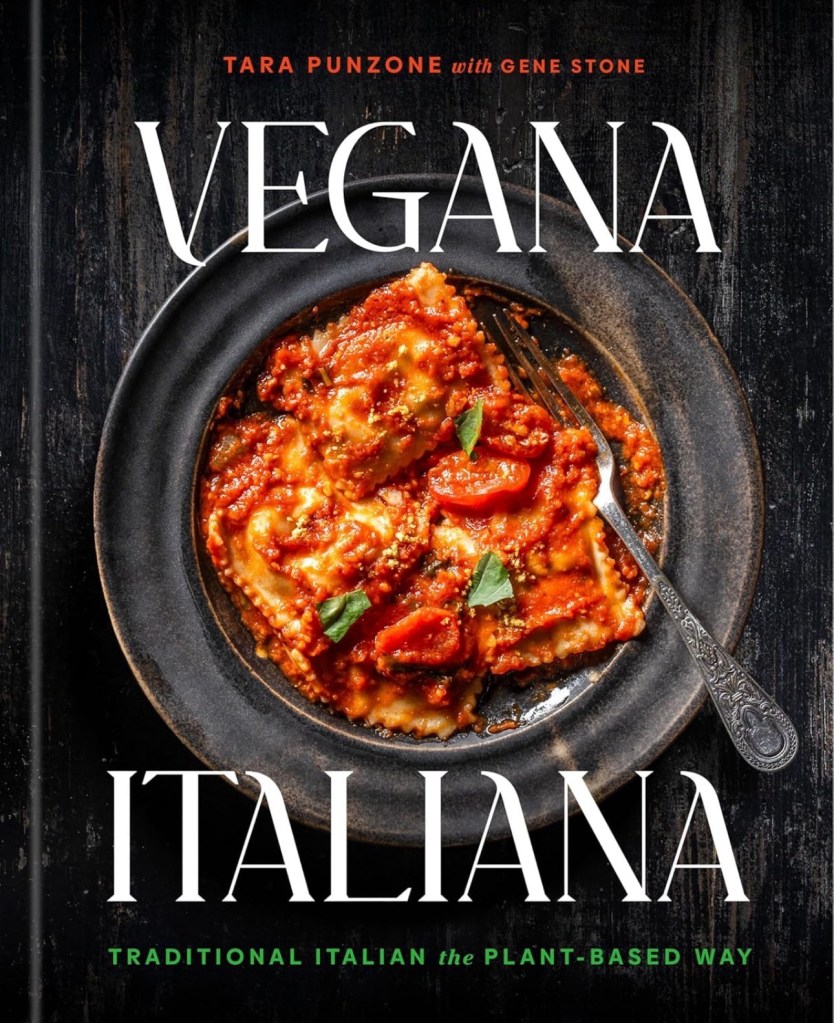
  • Not Yo Mamma’s Italian Cookbook: a review of Vegana Italiana by Tara Punzone

    Gone are the days where our only vegan pasta option is marinara!

    Vegan options at many Italian restaurants in my area are usually limited to pasta with marinara sauce without the cheese. I was glad to have a place at the table, but after ordering the same dish at every Italian restaurant, I was ready for some variety. Most Italian cookbooks from my library relied heavily on dairy cheese, so I looked online and found Tara Punzone’s cookbook, Vegana Italiana (written with Gene Stone), which offers over 100 recipes of veganized Italian cuisine. So far I have attempted the pasta dishes, sauces, and cheeses but Vegana Italiana also offers recipes on making pasta from scratch as well as salads, soups, first courses, second courses, and dessert.

    Tara Punzone is the owner and chef of Pura Vita, a vegan Italian restaurant in West Hollywood, California (Yelp page).

    Prior to opening this book, my Italian was mostly limited to musical terms (allegro!) and designer labels (Dolce and Gabbana). I loved eating pasta and could throw together some dry pasta and jarred marinara sauce, but my familiarity with dishes was limited to Alfredo, marinara, vodka, pesto, Chef Boyardee’s canned ravioli, and the mushy elementary school cafeteria spaghetti that was scooped like ice cream onto styrofoam trays. (If any of you remember that school lunch spaghetti, let me know!)

    Through Vegana Italiana, Tara Punzone has introduced me to cacio e pepe (DIVINE), spaghetti a la puttanesca (spicy and salty, yum!), and spaghetti aglio, olio, e peperoncino (simple and tasty).

    Al Dente

    A useful technique I learned from this book is to cook the pasta only a little more than half the time as instructed on the box, and then add pasta water to the sauce. This results in the noodles ready to soak up more moisture and flavor from the actual pasta sauce, and an al dente texture—deliciously firm to the bite.

    Loose-agna

    Emboldened by my success with the other recipes in the cookbook, I decided to play fast and loose with the sauce portions in the lasagna pura. I ended up with a mountain of wet pasta in which the lasagna kept slipping around the sauces. Lesson learned: follow the directions so that my lasagna looks like historic layers of geological sediment rather than messy hot lava.

    Adapting Ingredients to Fit My Budget and Tastebuds

    At first glance, some of the traditional ingredients were intimidating for my budget. Canned San Marzano tomatoes, highly regarded as the best for making pasta sauces, go for about $6 a can from what I’ve seen online! I’ve adapted the recipes to my wallet and pantry by using cheaper alternatives like regular tomatoes where the recipe calls for San Marzano tomatoes, and by occasionally going without the toppings like parsley or the crumbly bread.

    Also…in the course of preparing dishes from this cookbook, I learned that fresh parsley tastes like soap and peppery lawn mower clippings to me! I thought it was only cilantro that did that to certain people. Since my taste buds are cool with cilantro I may consider using fresh cilantro where parsley is listed as an ingredient.

    Among its recipes, Vegana Italiana also offers recipes for creating pasta noodles from scratch. I’d love to make these one day but in the meantime (let’s face it), I have a newborn! My main goal with this cookbook was to learn how to make more dishes, so to save time I’ve made them using store-bought ingredients like marinara sauce and dried pasta. The exception to this would be the creamy sauces like Alfredo, and cheeses like cashew ricotta and mozzarella.

    Since vegan Alfredo sauces are less readily available than marinara (and expensive at around $9 a jar), I’ve made the full batch of Tara Punzone’s cashew-based Alfredo sauce and stored the extra in glass jars in my fridge for later use. It’s heavenly, by the way: creamy and rich.

    My adaptations may be a bastardization of the cookbook but my point is that although the recipes in Vegana Italiana occasionally list specific ingredients like a certain type of salt or a canned tomatoes from a certain region, they are highly adaptable and flexible to one’s budget, taste buds, and pantry. If you want to be true to the restaurant-quality, original recipe then you have the information you need, and if you want to substitute ingredients with cheaper alternatives to fit your budget and pantry then you can do it and still create a great-tasting dish. This is a strong plus to me as a cookbook: for the price of a plate of pasta you can learn to make unlimited, obscene quantities of pasta wherever you are. For the price of a single plate of pasta (~$25), I’ve already made over $200 worth of pasta dishes.

    Where to Find Vegana Italiana

    Amazon

    Barnes & Noble

    Bookshop.org (support your local indie bookstore)

    Veganizing Cuisines Around the World

    I’m curious, what other cookbooks out there have deliciously veganized a culture’s cuisine for you? Leave a comment with your thoughts!
  • Seeing Dead People: where one’s past bleeds into the present

    Seeing Dead People: where one’s past bleeds into the present

    As I was about to give birth to my firstborn child, I began to see dead people in the faces of the people around me.

    It started during the second night of attempted labor induction. My husband was sleeping in the couch next to my bed. I lay in my bed, fading in and out of sleep, partially dilated and waiting for my baby to come.

    The door opened. One of the assistant night nurses walked into my room to take my blood pressure. I looked at her, saw my late friend Megan’s face, and did a double-take to check my reality. From her fine-textured blond hair to her blue eyes and the freckles on her face, and even her calm, rational demeanor, this nurse was my late friend Megan’s doppelganger. Megan had passed away suddenly in 2019 from a heart attack. I had seen her a few days before she died, and she had mentioned having angina and had an appointment with her cardiologist scheduled for the following week. But then her brother reached out to me when I was at work a few days later and told me that Megan had passed away in her condo.

    Although I knew this was not Megan, seeing someone with Megan’s face, hair, and body being alive and well in the world filled me with a sense of peace. It was like peering into a parallel universe in which a version of her was alive.

    I tried not to stare too hard.

    Was I going insane, trying to find the familiar in the unfamiliar?

    Or was my transition into motherhood bringing up feelings of loneliness and memories of old faces? I would have loved for Megan and my sister to meet Baby Daniel. And although I am willfully estranged from my parents, I grieve the relationship I wish I had with them…an emotionally safe one that does not exist.

    Or was I dying? Isn’t it a thing that people see their departed loved ones right before they die?

    Ultimately, the induction failed. After reaching 7 centimeters of dilation, I burned with fever from amniocentesis and Baby Daniel’s heart rate began dipping with each contraction. The nurse and doctor spoke to me and a few minutes later, I was rolled into the operating room for a c-section. Compared to the two nights of attempted labor induction, the c-section was quick and completed after 40 or so minutes.

    After the c-section, Baby Daniel was placed in a clear plastic bassinet in our postpartum room, next to my hospital bed. I reached over the edge of the bassinet to hold his tiny, soft hands—and before my eyes flashed the memory of my mother holding my sister’s stiff, gray hands in the casket.

    I gazed at Baby Daniel and saw the baby eyes of my sister staring back at me. But perhaps all newborns look the same: freshly decompressed from being squished inside a uterus for the past several months.

    Daniel was conceived not long before or after my sister’s death. Because of the close timing of the two events, I could not think of one without remembering the other.

    I have found it is more socially acceptable to celebrate than it is to grieve. Celebrations are social, but grief is personal. One’s celebration makes others feel good. One’s loss makes others feel uncomfortable—partly because different people grieve differently and we don’t know how to comfort everyone (some want to be left alone, others don’t want to be alone). Grief has a shelf life, a socially accepted window of time in which it is okay, or even expected, to express grief, and after that window closed, I felt I was supposed to shift, at least publicly, to being excited about my pregnancy. It was easier for others to celebrate with me about the pregnancy than to grieve with me about my sister. It felt like I was supposed to be excited now since I was pregnant, even though my sister’s death was nearly as fresh as my pregnancy.

    But the thing was, although I was happy about the pregnancy, I was still dealing with the emotional fallout of my sister’s suicide, my estrangement from my parents, and the childhood trauma I had spent most of my adulthood avoiding.

    Needing the space and time to grieve, I withdrew into myself.

    And now, as I navigate new parenthood and Baby Daniel’s first days in this world, my mind straddles the past and present, grasping for connections, no matter how tenuous.

    My Mother’s Motherhood

     As a new parent, I have finally reached the same life stage I’ve only ever known my parents to be in. My mom had me when she was 20. My dad was 27. During the dark hours of the morning I wonder what it might have been for my mom, who had met my dad through a matchmaker in her village and then moved across an ocean to marry him and have a baby without any family or extended relatives in America.

    Baby knowledge was harder to come by in 1990, when I was born. Nowadays I can enter a search or question in Google or parenting forums for informal advice and parenting perspectives and anecdotes, but back then, my mom would have relied on whatever she learned while growing up or asking people, or maybe a book. Without her “village,” my mom was left to handle a newborn baby equipped with only her own knowledge and instincts. I don’t know how she treated me as a baby.

    When I was six, my brother was born, at 8.5 pounds. I pretended to sleep while my mom held and screamed at my baby brother to sleep. Her thunderous voice and the rage behind it scared me. Silently, beneath the covers of my bed, I begged to God to make my brother stop crying. But he would keep crying all night long.

    My sister was born seven years after my brother, at 10.5 pounds. She would also cry a lot at night. While trying to rock my crying sister to sleep, my mom would get frustrated and say things like “hope your whole family dies” (sounds more succinct in Chinese) and “I wish I had aborted you,” which makes me suspect my sister was a surprise baby.

    Nowadays, a web search reveals tips and advice for dealing with a fussy baby. And a foray into parenting forums would find other parents with whom one could commiserate about baby sleep issues. My mom had none of these resources in the ‘90s. On top of that, my mom had left behind her family and friends when she moved to the United States to marry my dad.

    On one hand, my mom was making the most of what she had. But then I remember the physical, emotional, and sexual abuse she inflicted on me and the rest of the family—deep harm that her lack of knowledge or trauma cannot justify, harm that eroded the confidence of her children, and harm that comes from denying the harm that she and my dad inflicted. After remembering these things, I remind myself that having a hard life does not excuse her decision to abuse us. Then I feel angry. And the cycle of thought repeats until I get tired of it and start scrolling through Amazon for a quick distraction.

    I’m filled with gratitude for the resources I do have today. My husband shares household tasks and nighttime shifts with me. I go to therapy. I have access to internet resources and forums that offer tips and anecdotes that help me feel less alone. I’m no longer in touch with my toxic parents so they cannot add to my level of stress.

    Regression & Upheaval

    Becoming a new mom has sifted old memories from the bottom of my pond into the surface. How was my mom when I was a child? How will I be as a mother to my own child? I catch myself sliding back into memories, hangups, and issues I thought I had already processed. Childhood abuse. Sexual abuse. Why are we going through this again?

    In a recent therapy session I expressed grief about the relationship I wished I’d had with my parents. But this was something I’d worked through several months ago. My therapist asked if I was reconsidering my estrangement (a hard no) or if I just wanted to express my feelings of grief (yes), and suggested that instead of using the word “regress,” I can use the word “upheaval” to reframe this resurgence of old memories amid my transition into motherhood.

    I have also been thinking about my sister’s suicide. My mind has preoccupied itself with futile exercises such as wondering how things were like for her during her last days and moments, imagining the pain she must have felt for a long time, and what abuse she suffered alone from our parents. And feeling shame by how I had let myself assume my mother had somehow softened and changed with two subsequent children, even though the likelier truth was that she had learned to hide her worst impulses from me after I moved out. I also think about how I failed my sister by playing along with our parents’ “happy family” façade.

    On the outside, I looked like I was functioning well. My sister wouldn’t have seen the anger that simmered just beneath the surface, or how growing up with my mother’s temper and my dad’s enabling had molded me into an anxious, self-hating, fearful people-pleaser. My sister must have felt so alone in her own experience. She was in so much pain but could not see it reflected in anyone but herself, because I was hiding it deep inside me all along.

    During late night feedings at 2 AM, I look at Baby Daniel and see my sister’s eyes staring back into my soul. It is too late for me to save my sister but I can still protect my baby.

    The “Shit Pie” Metaphor

    Recently I came across the “shit pie” metaphor for situations in which abuse has occurred, where things are great when they’re good, and terrible when they’re bad: If you are eating a pie, and it’s an amazing, delicious pie with fresh, luxurious ingredients, but then you find out there is also shit in that pie, do you keep eating that pie? When I feel conflicted about my decision to cut off contact with my parents, I think of the pie and how sad it is to throw away a whole delicious pie because of a piece of shit in it. It doesn’t matter how good the rest of the pie is; the shit has contaminated it and made the entire pie unsafe to eat.